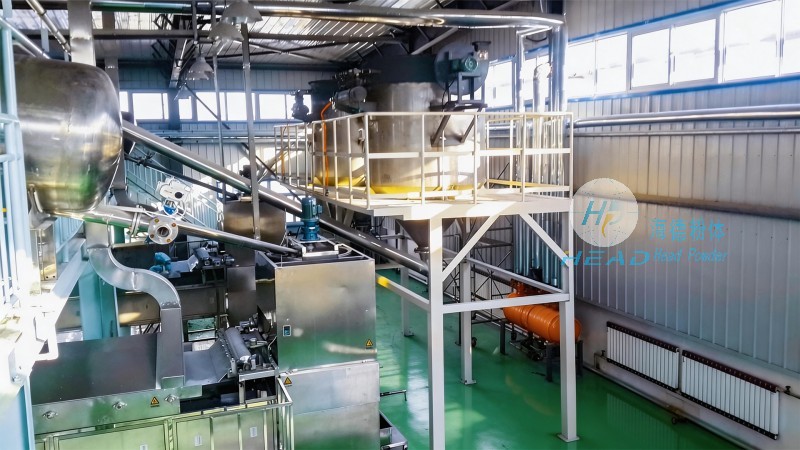
Case
titanium dioxide is a white solid powder with excellent optical properties such as high refractive index and good UV shielding capabilities. Its chemical properties are stable, acid and alkali resistant, and it is not easy to react chemically with other substances. The crystal structure of titanium dioxide is cubic crystal system, with a melting point of about 1850°C and a density of about 4.3g/cm3. In terms of physical properties, titanium dioxide has good dispersion and flow properties, making it easy to handle and use in various industrial applications. Common conveying methods of titanium dioxide include pneumatic conveying, spiral conveying, vibration conveying and belt conveying. When choosing a titanium dioxide conveying method, factors such as material characteristics, conveying distance, conveying volume, conveying speed, and whether there are special conveying needs should be comprehensively considered. Pneumatic conveying is suitable for long-distance and large-flow conveying; Spiral conveying is suitable for small and medium distance and medium flow conveying; Vibration conveying is suitable for short-distance, small-flow conveying; Belt conveying is suitable for medium to long distances and large flow conveying.

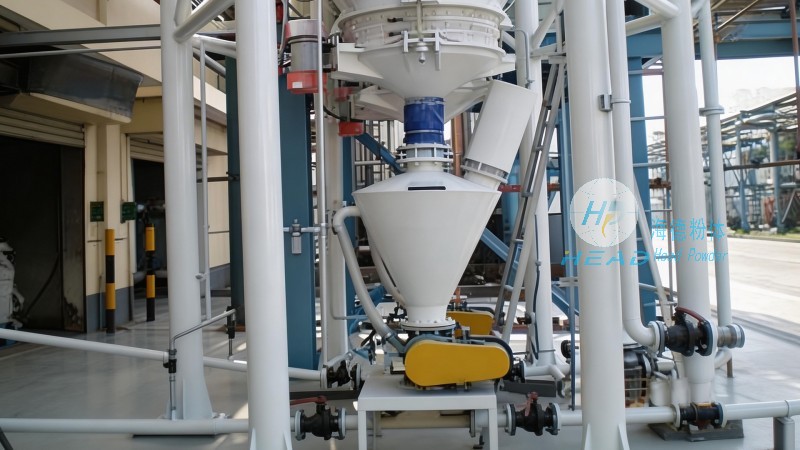
The common conveying methods of titanium dioxide are divided into mechanical conveying and pneumatic conveying. Mechanical conveying relies on the movement of mechanical components, which is a traditional basic method, suitable for short distances, low height, and small flow scenarios, including screw conveyors, bucket elevators, belt conveyors, and scraper conveyors, each with its own unique principles and characteristics. The screw conveyor realizes the continuous transportation of materials through the rotation of the spiral blades; The bucket elevator uses a lifting bucket to circulate the material in the elevator; The belt conveyor moves along a fixed track through the belt material with a belt; The scraper conveyor uses the scraper to push the material forward. Pneumatic conveying uses airflow energy to transport materials in closed pipelines, which is the core technology of material processing, warehousing, and packaging, and selects appropriate transportation methods according to material characteristics to improve efficiency and safety.

titanium dioxide is ideally suited for pneumatic conveying systems due to its fine particles, moderate density, good fluidity, and no significant bonding. This conveying method uses compressed air or vacuum as a power source to form an airflow in a closed pipe to carry the material and achieve gas-solid separation through a separator. Pneumatic conveying systems can be divided into negative pressure suction type, positive pressure pressure pressure conveying and hybrid type according to the conveying pressure and power form, while gas-solid mixed concentration usually adopts dilute phase conveying to ensure the efficiency and airtightness of the conveying process.

titanium dioxide pneumatic conveying is an efficient and energy-saving material conveying method that uses airflow to drive the powder in the pipeline by mixing titanium dioxide powder with gas. The system includes gas source, conveying pipeline, silo, controller and other parts, which has the advantages of large conveying capacity, long transportation distance, easy operation and high safety, and is widely used in chemical, building materials, food and other industries.

titanium dioxide pneumatic conveying has the advantages of high conveying efficiency, low energy consumption, long transportation distance, strong adaptability, wide range of particle size of conveyed materials, easy operation, safety and reliability, especially suitable for the transportation of powder, granular and lumpy materials, and is widely used in chemical, building materials, food, medicine and other industries.
When selecting a titanium dioxide pneumatic conveying system, it is necessary to comprehensively consider factors such as the physical properties of the conveying medium, the conveying distance, the conveying volume, the material of the conveying pipeline, and the requirements of the control system, while ensuring that the conveying equipment can meet the needs of production efficiency, energy consumption and safety, and take into account dust control, environmental regulations and the convenience of equipment maintenance.
Hyde titanium dioxide pneumatic conveying system achieves precise control of dust particles during the conveying process and reduces environmental pollution with its efficient, stable and safe characteristics. The system adopts advanced technology to ensure a smooth and smooth conveying process, effectively reduce energy consumption, and has good corrosion resistance and wear resistance, making it suitable for various working conditions and providing users with efficient and reliable conveying solutions.
titanium dioxide pneumatic conveying method has the advantages of high conveying efficiency, good conveying quality, and fast conveying speed, but it also has disadvantages such as high energy consumption, easy wear and tear of equipment, and complex system. With years of industry experience, Hyde Powder can tailor conveying solutions for thousands of materials, and is committed to simplifying the material conveying process and improving the overall performance of the conveying system. This service model has received widespread attention, and users have different opinions on it, so please share your views in the comment area. Hyde Powder is committed to making material transportation more efficient and convenient!

 Shandong Haide Powder Engineering Co., Ltd
 156-6277-7102(Manager Zhang)
  0531-83386006
  No. 1 Shanggao Industrial Park, Zhangqiu District, Jinan City, Shandong Province
 telephone
top