calcite is a calcium carbonate mineral, its main physical and chemical properties include hardness 3-4, density about 2.6-2.8 g/cm3, non-conductive, melting point of about 825 °C, with obvious cleavage surface, easy to crack along the cleavage surface. Calcite dissolves easily in acids and dissolves to form carbon dioxide gas and water. It is widely used in industrial fields such as building materials and chemical raw materials. The common transportation methods of calcite mainly include belt conveying, spiral conveying, pneumatic conveying, etc. When choosing a calcite transportation method, the characteristics of the material, the transportation needs, and whether there are other transportation needs should be taken into account. At present, the common calcite conveying methods in the industry mainly include the following types: belt conveyors are suitable for long-distance and large-volume transportation; Screw conveyors are suitable for short-distance and small-volume conveying; Pneumatic conveying is suitable for long distances and harsh environments.


calcite are mainly divided into mechanical conveying and pneumatic conveying. Mechanical conveying relies on the movement of mechanical components, which is a traditional basic method, suitable for short distances, low height, and small flow scenarios, including screw conveyors, bucket elevators, belt conveyors, and scraper conveyors, each with its own unique principles and characteristics. The screw conveyor realizes the continuous transportation of materials through the rotation of the spiral blades; The bucket elevator realizes the vertical transportation of materials through the cyclical movement of the lifting bucket; The belt conveyor uses the continuous movement of the belt to achieve horizontal or inclined conveying of materials; The scraper conveyor pushes the material along the conveyor through the scraper. Pneumatic conveying is the use of airflow energy to transport materials in closed pipelines, which is the core technology of material processing, warehousing and packaging, which is suitable for material transportation with different characteristics, and has the advantages of high transportation efficiency, low energy consumption, and wide range of application.

calcite is very suitable for pneumatic conveying due to its fine particles, low density, good fluidity and no obvious adhesion. The pneumatic conveying system uses compressed air or vacuum as the power source to form an airflow belt material through a closed pipe, and uses a separator to achieve gas-solid separation. According to the conveying pressure and power form, pneumatic conveying can be divided into negative pressure suction type, positive pressure pressure conveying type and mixed type, while gas-solid mixed concentration mostly adopts dilute phase conveying mode.

Calcite pneumatic conveying is a transportation method that transports fine-grained materials such as calcite through pipelines to a designated location. It uses compressed air as a power to form a pneumatic flow of materials in the pipeline to achieve continuous transportation of materials. This technology has the advantages of long conveying distance, large conveying capacity, low energy consumption, and easy operation, and is widely used in mining, building materials, chemical and other industries. In the process of transportation, through the reasonable design of conveying pipelines, the selection of appropriate conveying equipment and the control of conveying parameters, the stable transportation of calcite and other materials can be ensured and production efficiency can be improved.
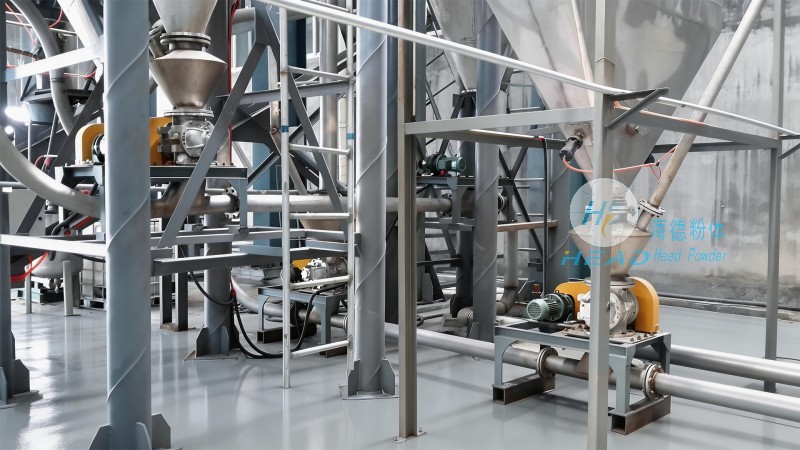
calcite pneumatic conveying has the advantages of long conveying distance, large conveying capacity, stable operation, low energy consumption, small bending radius of the conveying pipeline, wide adaptability to material particle size, and continuous transportation, which can effectively reduce production costs, improve production efficiency, and have the characteristics of environmental protection, safety and reliability.
calcite pneumatic conveying selection precautions include: first, choose the appropriate conveying equipment according to the particle size, humidity, dust content and other characteristics of calcite; secondly, consider the transportation distance, transportation volume and diameter of the transportation pipeline; Furthermore, pay attention to the material and strength of the conveying pipeline to ensure the stable operation of the conveying system; In addition, the wiring of the conveyor system is reasonably designed to ensure a smooth conveying process; Finally, pay attention to the safety performance of the conveyor system, such as dustproof, explosion-proof, etc., to ensure production safety.
Hyde Calcite Pneumatic Conveying System has shown obvious advantages in the field of material handling with its advanced design and excellent performance. The system adopts high-efficiency and energy-saving conveying equipment to achieve stable transportation of calcite and other materials, effectively reducing energy consumption and operating costs. At the same time, its unique sealing structure effectively prevents dust leakage and ensures a clean production environment; In addition, the system is easy to operate and easy to maintain, bringing users a convenient production experience.
calcite pneumatic conveying method has the advantages of high system conveying efficiency, good conveying quality and fast conveying speed, but it also has disadvantages such as high energy consumption and complex equipment maintenance. With years of industry experience, Hyde Powder designs conveying solutions for thousands of materials and is committed to simplifying the material conveying process. What do you think about this, welcome to leave a message in the comment area to discuss. Hyde powder makes material handling easier!

 Shandong Haide Powder Engineering Co., Ltd
 156-6277-7102(Manager Zhang)
  0531-83386006
  No. 1 Shanggao Industrial Park, Zhangqiu District, Jinan City, Shandong Province
 telephone
top