News
聚焦海德风采动态,分享行业技术资讯Mineral pneumatic conveying, in essence, is a technology that uses gas (typically air or compressed air) as a driving force to transport solid particulate materials (such as ore, coal powder, cement, etc.) within pipelines. It belongs to the category of pneumatic conveying systems, with its core being the movement of gas-solid two-phase flow to transport materials from the supply point to the receiving point. This conveying method does not rely on the friction or contact of mechanical components, thus avoiding wear and blockage issues that may exist in traditional belt, bucket elevator, and other equipment.
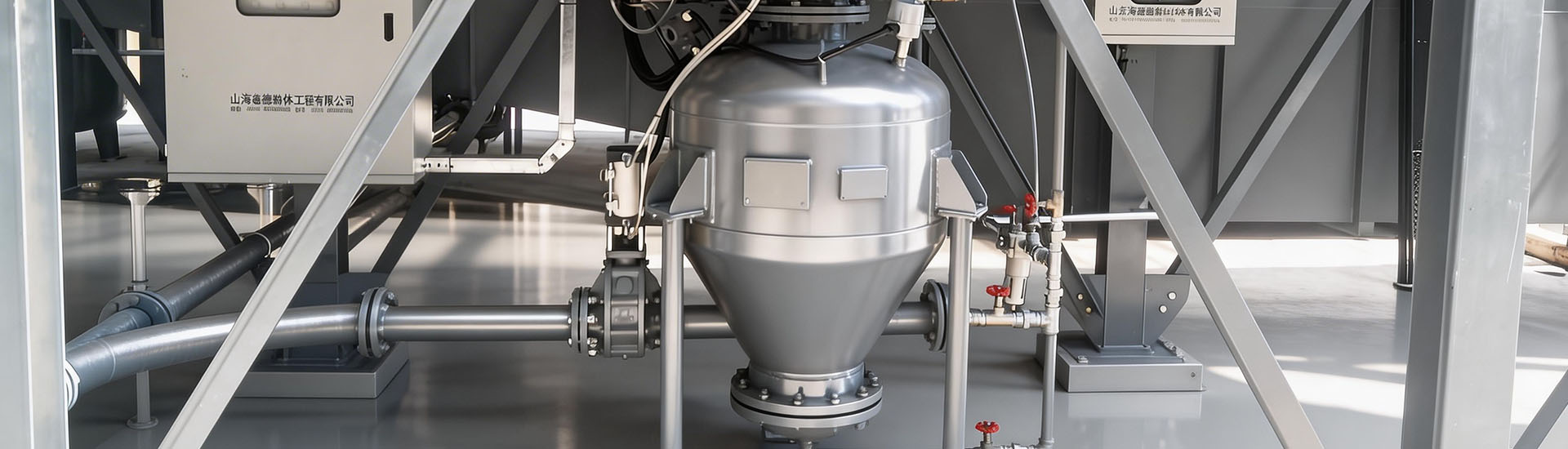
Mineral pneumatic conveying systems are generally divided into two main types: suction and pressure. The suction system generates negative pressure through a vacuum pump to draw materials into the conveying pipeline from the supply point; the pressure system uses a compressor to generate positive pressure and push materials into the pipeline from the supply point. Taking the suction system as an example, materials first enter the feeder (such as a star valve or screw feeder) under vacuum, are drawn into the conveying pipeline, mixed with air to form a gas-solid two-phase flow, and then transported to the receiving point through the pipeline. The materials are then separated from the air by a separator. The entire process ensures stable material transport by controlling parameters like vacuum degree and air flow velocity, while maintaining high system efficiency.

Compared with traditional mechanical conveying methods, mineral pneumatic conveying has significant advantages. First, it achieves dust-free or low-dust transport, effectively controlling dust pollution and meeting modern industrial environmental requirements. Second, the system structure is simple, with small footprint and flexible installation, capable of adapting to complex site layouts such as mountainous areas or narrow spaces. Additionally, pneumatic conveying systems operate stably with low maintenance costs, capable of handling various types of ore with different properties, including fragile, sticky, or highly abrasive materials, ensuring material integrity during the conveying process. For mining enterprises requiring long-distance, large-capacity transport, pneumatic conveying provides an efficient and reliable solution, significantly improving production efficiency and reducing operating costs.

Mineral pneumatic conveying is widely applied in multiple industrial fields. In the mining industry, it is commonly used for conveying ore after crushing in open-pit or underground mines, transporting crushed ore from the crusher to the concentrator. In the metallurgical industry, it is used for the continuous supply of blast furnace raw materials, such as iron ore and coke. In the chemical industry, it is used for the transport of powder or granular chemical raw materials, such as cement and limestone. For example, a large open-pit mine adopted Haidi's brand of mineral pneumatic conveying system, achieving automated transport from the ore stockpile to the concentrator, with a conveying distance of several kilometers. The material transport efficiency was improved by over 30%, while reducing manual operations and dust pollution, and received high customer recognition.

If you are facing issues like low ore transport efficiency, high environmental pressure, or complex site layout, Haidi's professional mineral pneumatic conveying system may bring you breakthrough solutions. We provide integrated services from design, manufacturing to installation and commissioning, customizing the optimal solution according to your specific needs, to help your industrial production be more efficient and environmentally friendly. Contact us now to get professional mineral pneumatic conveying solutions and start a new chapter in industrial transport.

 Shandong Haide Powder Engineering Co., Ltd
 156-6277-7102(Manager Zhang)
  0531-83386006
  No. 1 Shanggao Industrial Park, Zhangqiu District, Jinan City, Shandong Province
 telephone
top